


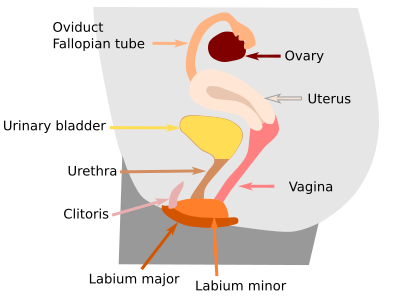
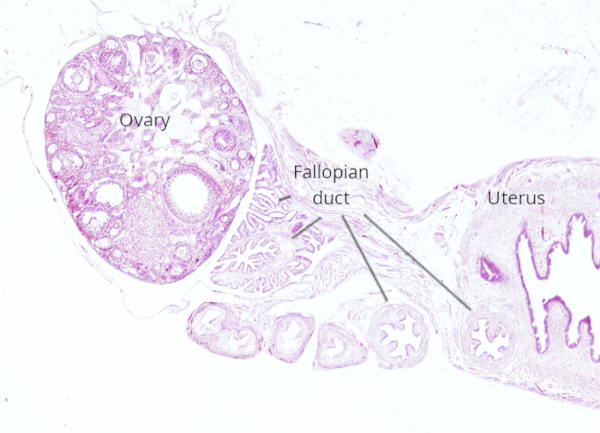
The female reproductive system produces egg cells, the female gametes. In mammals, if fertilization happens, the embryo is implanted in the female reproductive ducts, where posterior development occurs until birth. The physiology of the female reproductive system is different depending on whether there is fertilization or not. Several components of the female reproductive system can be distinguished: ovaries (or female gonads), reproductive ducts, and external genitals (Figures 1 and 2).
1. Ovary
Ovaries perform two main functions: producing gametes (egg cells) and releasing hormones like estrogens and progestagens (a family of hormones that includes progesterone), which are steroid hormones. Ovaries are a pair of organs located in the pelvic cavity, on both sides of the uterus. Although their shape changes during the menstrual cycle, measuring around 3–4 cm long, 1.5 cm wide, and 1 cm thick in humans.
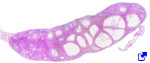
Each ovary is divided into the ovarian surface epithelium, tunica albuginea, cortical region, and medullary region. The surface epithelium is the outermost layer of the ovary, made up of cuboidal or squamous cells derived from the visceral peritoneum (mesothelium). The tunica albuginea is a layer of dense connective tissue found immediately beneath the surface epithelium. The ovarian cortex comes next. It is a more or less compact stroma containing ovarian follicles at various developmental stages. Each ovarian follicle is composed of somatic cells wrapping an oocyte. The oocytes produced during embryonic development and arrested in meiotic prophase I are stored in the cortex. During each menstrual cycle, one or several of these arrested follicles resume meiosis, and the follicle develops. Surrounded by the cortex, the ovarian medulla is found in the inner region of the ovary, although it is difficult to find a clear boundary between the medulla and the cortex. The ovarian medulla is fibro-elastic tissue with abundant blood vessels and nerves, both entering and leaving the ovary through the hilum. There are no ovarian follicles in the medulla.
In humans, each ovary is attached to the posterior surface of the broad ligament of the uterus through a fold of the peritoneum called the mesovarium. The upper part of the ovary is linked by the lumboovarian ligament to the wall of the pelvis. The nerves and blood vessels supplying the ovary run through this ligament. The lower part of the ovary is attached to the uterus by the ovarian ligament.
Oocytes are derived from oogonia, the female germinal cells, during the embryonic period. Oogonia are developed from the primordial germinal cells, which are formed before the development of gonadal ridges into the ovaries. An initial period of proliferation by mitosis yields about 5 to 7 million oogonia in human embryos. During the sixth month of fetal development, proliferation stops and oogonia become primary oocytes by meiosis. The meiotic process is arrested in prophase I, before the first meiotic division. Arrested oocytes are distributed throughout the developing ovarian cortex. They remain arrested in this location until follicle maturation begins during the first menstrual cycle. Meiosis is resumed only for those oocytes to be released during each ovulation. In humans, the second meiotic division starts after fertilization.
Ovarian follicles are made up of somatic cells and one oocyte. The somatic cells form the environment for the proper oocyte development. The size of an ovarian follicle is indicative of the developmental stage of the oocyte. The maturation process of the follicles is divided morphologically into three stages: primordial, growing (primary, secondary, and tertiary follicles), and mature (graafian follicles).
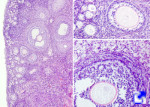
Primordial follicles are found just beneath the tunica albuginea. They consist of one cell-thick layer of somatic cells wrapping a single oocyte, which is arrested in prophase I. Somatic cells are flat to cuboidal and are in close contact with the oocyte. The follicle is separated from the surrounding stroma by a basal lamina.
Those follicles that start growing begin to mature and will eventually release a fully developed egg cell (ovum) during ovulation. Depending on the author and the developing stage, follicles are named specifically. Primary follicles show an increase in the size of the oocyte, and the follicle somatic cells wrapping the oocyte change from flattened to cuboidal shapes. Furthermore, the zona pellucida is visible between the oocyte and the somatic cells. As development progresses, follicle somatic cells proliferate and are arranged into several layers, known as the granulosa layer. Stroma cells surrounding the granulosa layer reorganize to form a multi-layered sheath made up of flattened somatic cells known as theca. The theca becomes thick, and it can be divided into an internal and an external part. The granulosa layer is separated of the theca layer by a basement membrane. Throughout the follicle developmental process, besides growing in size, the oocyte matures by reorganizing the cytoplasm, storing cortical granules below the cell membrane, forming microvilli, and making other cell changes. Secondary follicles, or antral follicles, develop a cell-free space among the granulosa cells. This space is the antrum, which is formed when granulosa layer reaches around 5 layers of cells. Now, the oocyte stops growing. However, follicle somatic cells keep proliferating, and the follicle gets bigger, including the antrum. The oocyte is separated from the granulosa, yet a cluster of granulosa cells remain surrounding the oocyte. These granulosa cells and the oocyte are now isolated from the rest of the granulosa cells in the antrum, except for a bridge of granulosa cells known as discus proligerus or cumulus oophorus. These somatic cells around the oocyte will later, during ovulation, form the corona radiata.
The mature follicle, or graafian follicle, is so big that it pushes the ovarian tunica albuginea outward. The antrum takes almost all the inner follicular space, and the oocyte, along with the surrounding somatic cells of the corona radiata, is disconnected from granulosa cells just before the ovulation. Theca cells are now well-developed. Both theca and granulosa cells release androgen and estrogen hormones, respectively. Following stimulation by luteinizing hormone released by the hypophysis, the oocyte resumes meiosis and completes the first meiotic division to become a secondary oocyte. It is in this stage that the oocyte is released from the follicle, a process known as ovulation.
Once the egg cell is released, the somatic cells of the follicle form the corpus luteum. They produce progesterone and estrogens that stimulate the cells that form the uterine wallsto eneable embryo implantation. If there is no fertilization, the corpus luteum degenerates several days after ovulation. If fertilization happens, the corpus luteum grows and continues to release progesterone and estrogens, mainly during the first weeks of pregnancy.
2. Oviducts
The egg cells released during ovulation are collected in the fallopian tube, also known as the uterine tube, which leads to the uterus. There are two fallopian tubes, one for each ovary. In humans, they are about 10 to 12 cm long. Fertilization and part of the early embryonic development take place inside the fallopian tubes. The embryo arrives at the uterus during the blastocyst stage of embryonic development. Sperm cells need to swim a long way, including the uterus wall and a long portion of the fallopian tubes, before they contact the egg cell for fertilization.
The fallopian tube is divided into several parts. The infundibulum, or pavilion, is found near the ovary, has a funnel-like shape, and collects the egg cell right after ovulation. The longest part of the fallopian tube is the ampullary region, which is about two-thirds of the total length. Fertilization occurs in this segment. The isthmus is near the uterus, and represents the narrower part of the fallopian tube. The interstitial, or intramural, part of the fallopian tube enters the walls of the uterus and connects with the internal cavity of the uterus.
The wall of the fallopian tubes consists of an inner serous layer, or visceral peritoneum, made up of mesothelium and a thin layer of connective tissue. Towards the lumen, there is a layer of smooth muscle divided into a longitudinal outer layer and a thicker circular inner layer. In contact with the lumen, a mucosa layer features longitudinal folds protruding into the lumen. The mucosa is made up of connective tissue and a simple columnar epithelium with two types of cells, ciliated and non-ciliated. The movement of the cilia propels the egg cell toward the uterus. Non-ciliated cells are secretory cells that release nourishing substances for the egg cell. The proportion and shape of these two cell types changes during the menstrual cycle. Estrogens promote more ciliated cells and an increase in cellular height. The egg cell cannot move by itself, so it is driven by ciliated cells and the peristaltic movements of the fallopian tubes. Sperm cells travel in the opposite direction, toward the ovary. Besides the movement of the flagellum, it is not known what mechanism pushes sperm cells through fallopian tubes to meet the egg cell.
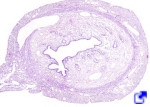
The uterus is the compartment of the reproductive ducts where most embryonic development takes place. It is found between the fallopian tubes and the vagina. In humans, it is around 7.5 cm long. The uterus is divided into a superior part, or body, and an inferior part, or cervix. The wall of the uterus is thick and divided into three layers: the endometrium, or uterine mucosa, is a layer composed of simple columnar epithelium and connective tissue; the myometrium, or muscular layer, is continuous with the muscle of the fallopian tubes; and the perimetrium, which is the peritoneal layer. The endometrium and myometrium undergo major changes during menstrual cycles. When fertilization takes place, the embryo attaches to the endometrium (implantation) and eventually invades the uterus wall to form the placenta. The placenta consists of two components: the chorion, derived from the embryo, and the decidua, derived from the endometrial layer. The mucosa of the cervix is morphologically different because it has exocrine glands that release more or less dense mucous substances according to the point of the menstrual cycle, facilitating or inhibiting the entrance of sperm cells in the uterus.
The vagina is the receptacle for the male sexual organ and communicates the uterus with the vestibule of the vulva, which is the part of the vulva located between the two labia minora. The vaginal wall is formed of a thin mucosa with a stratified, usually non-keratinized, squamous epithelium. Below, there is a layer of smooth muscle divided into two sublayers, one circular and one longitudinal. The longitudinal one is thicker, and it is continuous with the muscle layer of the uterus. There is striated muscle in the part of the vagina near the vulva. Wrapping the muscle layer, there is an adventitia layer of dense connective tissue, followed by loose connective tissue. The vagina does not contain glands, and its lubrication is caused by the secretion from glands located in the cervix of the uterus. The outer lubrication of the vaginal entrance is produced by glands located between the labia of the vulva.
3. External genitalia
The vulva is the external female reproductive organ. It includes the mons pubis, labia majora, labia minora, clitoris, and the vulva vestibule. The mons pubis is a rounded elevation produced by subcutaneous adipose tissue. Labia are cutaneous folds with sweat and sebaceous glands. The external labia (labia majora) have hair follicles and smooth muscle. The clitoris is an erectile organ homologous to the penis, with cavernous bodies and a clitoral glans (hood). The vulvar vestibulum is lined with a stratified squamous epithelium containing many small mucous glands and other more complex tubule-alveolar glands that release their contents into the vaginal opening. These glands lubricate the external part of the female external organ. The external genitalia contain many touch and pressure sensory receptors, like Meissner corpuscles, Pacini corpuscles, and free-ending axons.
 Reproductive